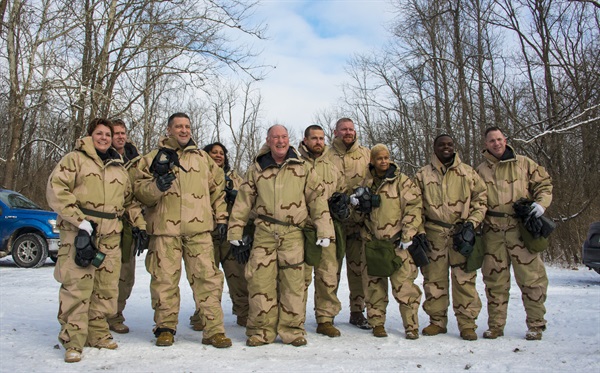
A group of some 55 of your wounded warriors and their families met lat week in Arlington to discuss the Army’s Wounded Warrior program.
The intent of this symposium – the second one in the last six months – is to understand and prioritize these issues as families navigate the maze of benefits throughout hospitalization, recovery, rehabilitation and transition back into the Army or their civilian community.
The discussions were udoubtedly helpful to improving how we assist our injured Soldiers to adapt and overcome, but to learn the stories of these young heroes is humbling.
SSG Holsey
Holsey isn’t looking to leave the Army. In fact, a second tour in Iraq wouldn’t bother him.
He recently reported to the basic non-commissioned officer course. At weigh-in Holsey noticed his peers eyeing his leg. The stares didn’t bother him. “I made people comfortable, I would say stuff like, ‘I’m gonna put my other leg on later,”’ Holsey said
1LT Folkerts
He was told he might never have use of his hand again. “I told them, ‘No, no I’m gonna keep fighting,’” Folkerts said. The lieutenant painfully sat in Walter Reed, hearing updates from his buddies still in Iraq. He felt guilty for not being there. Slowly, he regained some feeling in his hand.
For a time, he dodged the situation. “I kind of refused and almost denied that I had problems last year because I didn’t want to talk to anybody about it,” said Folkerts, who moved into an apartment on Fort Riley after leaving Walter Reed.
But he grew tired of feeling down about himself. So he visited family on weekends. Slowly, he began to accept and be comfortable with his disabled left arm.
“Just to be back in my unit and back in uniform and actually contributing really helped me out because I felt like I was part of the team again,” Folkerts said. Also helpful was sharing an apartment with two officers who returned from Iraq.
SPC Sele
An hour into the trip, Sele heard an IED detonate under the fuel tankers. The commander ordered him to guard the tankers as engineers determined whether the tankers could still be driven.
Then, from his perch atop the Humvee Sele spotted a small car approaching. “Hey, I got a suicide bomber coming in,” Sele shouted.
He was ordered to shoot.
Sele’s fire killed the driver, flattened the tires and silenced the engine. But the momentum of the vehicle continued towards the fuel tankers.
As Sele fought to get out of his harness, he heard the beeping sound of a detonator.
The explosion of both fuel tankers launched him a half mile. “Till now I still hear that beeping sound,” Sele said.
SSG Noel
He remembers waking up in a fog and hearing people scream “Get him out! Get him out!” He tried to move his arms and legs but couldn’t. Then he blacked out. His next memory was rolling out on a gurney from a tent hospital.
The IED had broken two of his ribs, one femur, both ankles, his scapula, cut his spleen and collapsed a lung. Everyone else died.
Following surgery to install a titanium support in his backbone, he should be able to leave the wheelchair behind. Noel hopes to return to Texas with his son, who is currently living with his grandmother in Washington state.
The spirit of these young men is simply amazing. I don’t know where America finds them, but I’m damned glad that we do. Sgt Hook out.
Posted by Hook @ 1244 zulu | | Permalink
This post is filed under: Army Times & Heroes & The Soldier
The Thunder Run linked with
Web Reconnaissance for 10/31/2006